Ceramic Membrane Filtration for Industrial Water & Wastewater Treatment | Cerafiltec
Ceramic Membrane Filtration for Industrial Water & Wastewater Treatment
Advanced Ceramic Membrane Technology | Reliable Filtration | Global Supply
Industries worldwide are increasingly seeking advanced water filtration technologies that deliver reliable performance, long service life and sustainable water management. From industrial process water and wastewater treatment to water reuse and reverse osmosis pretreatment, modern membrane filtration plays an important role in improving water quality and supporting efficient industrial operations.
WTB Water Solution Pte. Ltd. supplies water and wastewater treatment technologies and equipment to customers in international markets, supporting industrial projects with application-focused solutions and global export services.
One important technology for demanding filtration applications is Cerafiltec ceramic membrane filtration, which uses durable ceramic flat-sheet membranes for the treatment of challenging water streams.
What Is Ceramic Membrane Filtration?
Ceramic membrane filtration is a membrane separation process that uses porous ceramic materials to remove suspended particles and other contaminants from water.
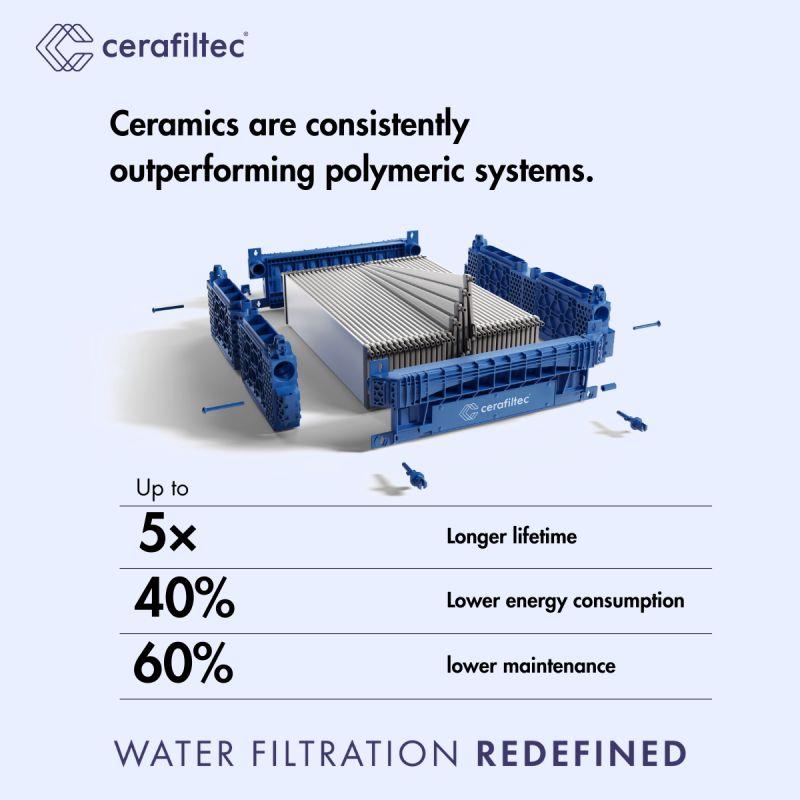
Compared with conventional polymeric membranes, ceramic membranes are designed for demanding operating conditions and can offer advantages in mechanical strength, chemical resistance and durability, depending on the membrane design and application.
Cerafiltec develops ceramic flat-sheet ultrafiltration technology for industrial and municipal water treatment. Its systems are designed for applications including surface water treatment, wastewater treatment, process water filtration and reverse osmosis pretreatment.
The appropriate membrane configuration depends on feed-water characteristics, required filtrate quality, operating conditions and the overall treatment process.
How Does a Ceramic Membrane Filtration System Work?
A ceramic membrane filtration system typically operates by passing feedwater across or through porous ceramic membrane surfaces under a controlled pressure difference.
During filtration, water passes through the membrane while suspended solids and other particles are retained, depending on the membrane's pore characteristics and system configuration.
A typical treatment process includes:
Feedwater supply: Water enters the filtration system from the selected source or upstream treatment process.
Membrane filtration: Water passes through the ceramic membrane while targeted suspended contaminants are retained.
Filtrate collection: Filtered water is collected for discharge, further purification or reuse.
Membrane cleaning: Backwashing, air-assisted cleaning or other suitable cleaning procedures help manage accumulated solids.
System monitoring: Flow, pressure, water quality and cleaning performance are monitored to support reliable operation.
The exact process sequence varies with the selected Cerafiltec module, application and plant design.
Key Benefits of Cerafiltec Ceramic Membrane Technology
1. Durable Ceramic Construction
Ceramic membranes are designed for demanding filtration environments. Their mechanical strength and resistance to many chemicals and elevated temperatures can make them suitable for applications where operating conditions are challenging.
2. Consistent Filtration Performance
Properly selected ceramic ultrafiltration membranes can provide effective removal of suspended solids, colloids and microorganisms. Actual removal performance depends on membrane specifications, water characteristics and system operation.
3. Potential for Long Service Life
Ceramic membrane technology can offer long service life under appropriate operating and maintenance conditions. This may reduce membrane replacement frequency and help manage lifecycle costs.
4. Reduced Maintenance Requirements
A suitable system design and effective cleaning strategy can help control fouling, maintain filtration performance and reduce unnecessary maintenance interventions.
5. Chemical and Temperature Resistance
Ceramic materials can tolerate a range of chemical cleaning conditions and temperatures. The permitted limits must always be checked against the specific membrane product and manufacturer's operating guidelines.
6. Modular and Scalable Design
Modular membrane configurations can support new installations, treatment capacity expansion and selected upgrades to existing filtration systems.
7. Support for Sustainable Water Management
Ceramic membrane filtration can help facilities improve treated-water quality and create opportunities for wastewater recovery, reuse and more efficient water management.
Applications of Ceramic Membrane Filtration
Cerafiltec ceramic membrane technology can be considered for a variety of water and wastewater treatment applications.
Industrial Water Treatment
Ceramic membranes can be used to treat selected groundwater, surface water and other industrial water sources where suspended solids removal is required.
Industrial Wastewater Treatment
Depending on wastewater characteristics and process design, ceramic membranes can support the treatment of industrial wastewater containing suspended solids, colloidal material and certain difficult contaminants.
Wastewater Reuse and Recycling
Membrane filtration can form part of a treatment train designed to improve effluent quality for suitable non-potable reuse applications. Additional treatment or disinfection may be required according to the intended reuse standard.
Reverse Osmosis Pretreatment
Ceramic ultrafiltration can be used upstream of reverse osmosis to reduce suspended solids and colloids in the feedwater. Effective pretreatment can help manage the risk of downstream membrane fouling.
Municipal Water Treatment
Ceramic membrane filtration can be considered for selected municipal water-treatment applications, including surface water treatment and wastewater polishing.
Challenging Industrial Streams
Depending on the specific module and application, ceramic membranes may also be evaluated for oily wastewater, mining water, process water and other challenging industrial streams.
Ceramic Membranes vs. Polymeric Membranes
Ceramic and polymeric membranes both play important roles in modern water treatment. The right choice depends on the application rather than one technology being universally superior.
Ceramic membranes may be advantageous when:
High mechanical durability is important.
The process requires compatibility with demanding cleaning conditions.
Feedwater characteristics present challenging filtration conditions.
Long-term service life and lifecycle costs are key evaluation criteria.
Polymeric membranes may be advantageous when:
A particular polymeric product meets the required filtration performance.
Project capital cost and system configuration favour a polymeric solution.
Operating conditions are compatible with the selected polymer and cleaning procedures.
A proper comparison should evaluate membrane performance, energy demand, cleaning requirements, replacement costs, footprint and total lifecycle cost.
Why Choose WTB Water Solution Pte. Ltd.?
WTB Water Solution Pte. Ltd. focuses on supplying water and wastewater treatment technologies and equipment to customers worldwide.
Our international supply approach supports businesses seeking filtration systems, membrane technologies and equipment for industrial water-treatment projects.
Our Value Proposition
Global Supply and Export: Support for international equipment sourcing and delivery requirements.
Application-Focused Solutions: Technology selection based on water quality, capacity and treatment objectives.
Industrial Water Expertise: Solutions covering filtration, wastewater treatment, water purification and reuse.
Project-Oriented Support: Assistance with equipment requirements and coordination throughout the supply process.
Quality-Focused Approach: Emphasis on appropriate technology selection and reliable equipment supply.
For Cerafiltec ceramic membrane projects, product availability, technical support and any distributor-related services should be confirmed for the specific project and destination market.
How to Select the Right Ceramic Membrane System
Before selecting a ceramic membrane filtration system, project owners and engineers should assess:
Feedwater source and complete water analysis.
Required treatment capacity and peak flow.
Suspended solids, turbidity, oils and other relevant contaminants.
Required filtrate quality and final water-use requirements.
Membrane module specifications and operating limits.
Cleaning methods, energy demand and maintenance requirements.
Available installation space and integration with existing equipment.
Capital expenditure, operating costs and lifecycle performance.
Pilot testing or a detailed technical assessment may be appropriate when feedwater quality is variable or the application is particularly challenging.
Global Supply of Ceramic Membrane Filtration Solutions
Industrial water-treatment projects increasingly require dependable equipment sourcing and international coordination.
WTB Water Solution Pte. Ltd. serves global markets with water and wastewater treatment equipment and technology solutions. We welcome enquiries from industrial facilities, engineering companies, contractors, consultants and project developers seeking ceramic membrane filtration solutions.
Whether your project involves industrial water treatment, wastewater reuse, RO pretreatment or upgrading an existing filtration process, the right technology should be selected according to your technical requirements and operating objectives.
Frequently Asked Questions
What is a ceramic membrane filtration system?
It is a filtration system that uses porous ceramic membranes to separate suspended particles and other targeted contaminants from water.
What is Cerafiltec ceramic membrane technology used for?
Cerafiltec ceramic membrane technology is designed for applications that include industrial and municipal water treatment, wastewater treatment, process water filtration and RO pretreatment.
Are ceramic membranes suitable for industrial wastewater?
They may be suitable for many industrial wastewater applications. A water analysis and technical assessment are needed to confirm compatibility with the specific membrane and process.
Can ceramic membrane filtration be used before RO?
Yes. Ceramic ultrafiltration can be used as RO pretreatment to reduce suspended solids and colloids, subject to appropriate system design and feedwater conditions.
How long do ceramic membranes last?
Service life depends on the membrane product, feedwater quality, operating conditions, cleaning practices and maintenance. Always consult the manufacturer's specifications for the selected product.
Contact WTB Water Solution Pte. Ltd.
Looking for ceramic membrane filtration technology for your next industrial water or wastewater treatment project?
Contact our team to discuss your application, equipment requirements and international supply needs.
WTB Water Solution Pte. Ltd.
Advanced Water Treatment Technologies | Global Supply | Reliable Solutions
+6585224813
habib@wtb.sg
Clean Water. Better Tomorrow.
There are many variations of passages of Lorem Ipsum available, but the majority have suffered alteration in a our some form, by injected humour, or randomised words which don't look even slightly believable. If you are going our as to use a passage of Lorem Ipsum, you need to be sure there isn't anything embarrassing hidden in the middle the of text. All the Lorem Ipsum generators on the Internet tend.